|
Islamic
Regime of Iran’s
Gender
and Religious Apartheid
Human
Rights Abuses of Islamic Regime in
Iran
The right to a fair trial in
Iran
has been compromised by the 1994 Act establishing Public and Revolutionary
Courts, in which among other things, the responsibility of the Public
Prosecutor was transferred to the judge, to expedite hearing of the cases.
This clearly compromises the independence of the judiciary, in violation
of Article 10 of the United Nations Guidelines on the Role of Prosecutors,
which states that: “ The office of
prosecutors shall be strictly separated from judicial functions”, and
Article 14 of the International Covenant on Civil and Political Rights (ICCPR)
which provides for the right to be tried before an independent and
impartial tribunal.
We remain concerned by reports that
hundreds of people arrested in connection with student demonstrations in
July 1999 continue to be detained without charge or trial and that some
have been sentenced to long prison terms, or death, after manifestly
unfair trials by Islamic Revolutionary Courts.
Unprecedented rise in the prosecution and conviction of writers,
editors and publishers by special courts, whose procedures do not conform
to internationally recognized standards for fair trial, is a clear
violation of their fundamental rights.
United Nations Commission on Human Rights, Amnesty International,
Human Rights Watch Dog and other Internationally recognized organizations
for number of years have been denied access to visit
Iran
, due to the widespread and systematic sever Human Rights violations in
Iran
we urge the world community to pressure
Iran
to grant such visits and full observation of trials and jail visits.
MEHR Iran appeals to the world community and the democracies of the
world to pressure the Islamic Regime to practice the individual rights
enshrined in such instruments as the International Covenant on Civil and
Political Rights, to which the Islamic Republic of Iran is a state party.
World community should pressure
Iran
to observe without reservation, the Convention against Torture and other
Cruel, Inhumane or Degrading Treatments or Punishments.
United Nations Commission on Human Rights, Amnesty International,
Human Rights Watch Dog, and other internationally recognized organizations
have been denied access to visit
Iran
. We urge the world community to pressure
Iran
to grant such visits and allow full observation of trail and jail visits.
Mass
Executions of 1989
At the end of the Iran-Iraq war (1980-88) Ayatollah
Khomeini issued a secret religious decree setting up special commissions
with instructions to execute all political prisoners who were not clearly
repentant. These victims were largely Mojaheds, categorized as moharebs
(those who war against God), and leftist, labeled as mortads (apostates
from Islam).
The commissions questioned prisoners throughout the country to decide
which ones should receive the death penalty. The proceedings began with
assurances to the prisoners that the purpose of the undertaking was to
initiate a general amnesty. Then the commission members asked the
prisoners about “their organizational affiliation. If they replied ‘
Mojahedin’, the questioning ended there. If they replied 'monafeqin'
(hypocrites), the commission continued with such questions as’ Are you
willing to denounce former colleagues? ‘ ‘
Are you willing to help us hunt them down?’ ‘Will you identify phony
repentant?’ ‘ Will you go to the war front
and walk through enemy minefields?’ In most cases, the prisoners were
blindfolded throughout the proceedings. The socialists and communists were
asked,” are you a Muslim? Do you believe in God? Is the Holly Koran word
of God? Will you publicly recant historical materialism? Do you pray and
read the Holly Koran?”
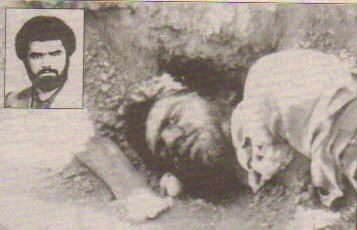
Vast majority was "Prisoners of Conscience" as they had
not been charged with actual deeds or plans of deeds against the state.
So far, more than 5,000 of these defenseless victims have been
identified.
Legalized
Torture
Ta’zir, or discretionary punishment, is a feature
in Islamic law. In 1980 the first parliament of the Islamic Republic
codified this provision of Islamic law by passing a bill giving judges
permission to mete out seventy-four lashes to those who, among other
things, kiss illicitly, fail to dress properly or lie to the authorities.
Clerical interrogators
can give indefinite series of seventy-four lashings until they obtain
“honest answers”. “Therefore if answers” are not satisfactory,
they can lawfully whipped for ‘lying’ in theory, this punishment
should come after a proper law court has found them guilty of perjury. But
the line between interrogation and trial is hazy as the same clerics wear
three different turbans-Prosecutor, judge, and interrogator. According to
the new law, interrogators with proper theological credentials are
entitled to lash until the guilty ‘confess the truth.’ The
constitution of the Islamic Republic forbids torture and coerced
confession, but Ta’zir law allows both physical punishment and voluntary
confession.
Under the bizarre justice system of the Islamic Republic,
convictions of the accused are primarily based not on evidence but on
confessions. Thus the use of torture as a tool to obtain confession is
built into the very structure of the theocratic order. Therefore, it is
quite logical that the presiding judge in the trial also functions as the
prosecutor. MEHR Iran appeals to world community to pressure Islamic
Republic to repeal Ta'zir law.
Islamic constitution has divided Iranians into supreme, ordinary and
inferior citizens.
Iran
has been declared as an Islamic society that the laws and the way of life
should conform to Islamic ways and means. Clerics are the ones with the
right of guidance and governance and they will choose among themselves the
Supreme leader, who has the ultimate saying in all aspects of legislation,
government affairs, judiciary, armed forces and any other personal or
public affairs of the society, who is not accountable to the people but is
to the GOD.
There are two main branches of Islam and each of them has numerous
factions within them. Islamic regime of
Iran
believes in an orthodox branch of shie’tt. About one fifth of the
Iranian population are Sunni Moslems, that by constitution can not be
chosen as supreme leader, President, judges, cabinet level ministers,
ambassadors, commanders of the armed forces members of the Guardian
Counsel, heads of the various governmental foundations and simply put it
any organization or entity which is influential in steering the country.
The same applies to other recognized religions such as Christians, Jews
and Zoroastrians.
Other religions beside these such as Bahai’s, Hindu’s and others
are not recognized and systematically are being persecuted and being
deprived from state sponsored programs such as health, welfare, education
and such other programs.
Religious
and Gender Apartheid by Islamic Regime
The marriage age for the girls in Iran is 9 lunar
years which conform to eight years and 9 month of solar calendar, in
western style democracies this is not an acceptable age and having sex
with a child of this age is being considered statuary rape, that is
punishable by the law. The physical torture and mental torment that an
eight year old child is having at her wedding night when she has to
sexually please a man at least two to three times her own age if not
older, is incomprehensible.
If having sex with an eight-year-old child is wrong in this society, then
it is wrong anywhere and any place, and our morality does not permit us to
reward such a government that harbors such laws to be our trading
partners, in place of legal action
Islamic constitution has divided Iranians into supreme, ordinary and
inferior citizens.
Iran
has been declared as an Islamic society that the laws and the way of life
should conform to Islamic ways and means. Clerics are the ones with the
right of guidance and governance and they will choose among themselves the
Supreme leader, who has the ultimate saying in all aspects of legislation,
government affairs, judiciary, armed forces and any other personal or
public affairs of the society, who is not accountable to the people but is
to the God.
There are two main
branches of Islam and each of them has numerous factions within them.
Islamic regime of
Iran
believes in an orthodox branch of shie’tt. About one fifth of the
Iranian population are Sunni Moslems, that by constitution can not be
chosen as supreme leader, President, judges, cabinet level ministers,
ambassadors, commanders of the armed forces members of the Guardian
Counsel, heads of the various governmental foundations and simply put it
any organization or entity, which is influential in steering the country.
The same applies to other recognized religions such as Christians, Jews
and Zoroastrians. Other religions beside these such as Bahai’s,
Hindu’s and others are not recognized and systematically are being
persecuted and being deprived from state
sponsored programs such as health, welfare, education and such other
programs. Some of the discriminatory laws of Islamic Republic faced by
minorities are:
Article 207 Islamic Criminal
Codes:
This section provides for punishment in the form of retribution (Ghesas)
when a Muslim is killed.
When the victim is a non-Muslim, the law is silent and by
construction, no punishment needs to be enforced. If a non -married Muslim
man commits fornication, his punishment is 100 lashes and if a non -Muslim
man fornicates with non-Muslim woman, the punishment is the same. However,
if the woman is a Muslim, the punishment for the non-Muslim man is death.
Article 121 of the Islamic
Civil Code:
The punishment for “homosexual touching” and
similar acts, if there is no entry, is 100 lashes. However, if the subject
is a non-Muslim and the object a Muslim, the punishment for the subject is
death.
Article 881 of the Civil
Code:
A non-Muslim shall not inherit from a Muslim if among the heirs of the
deceased there is a Muslim.
Article 163 of the Constitution
and the conditions for selection of Judges Code:
Only a male Muslim may become a Judge.
Articles 297 and 300 of the Civil
Code:
These rules provide for blood money (Deyeh) for the killing of a Muslim
man or woman. Blood money for the Muslim woman is one half of the same for
the Muslim man. When the victim is a non- Muslim the law is silent. By
construction, non-Muslims are not entitled to blood money.
|